
Project example: a 2-car flake epoxy garage floor with cracks in Dallas Ranch — what it involves and what it costs
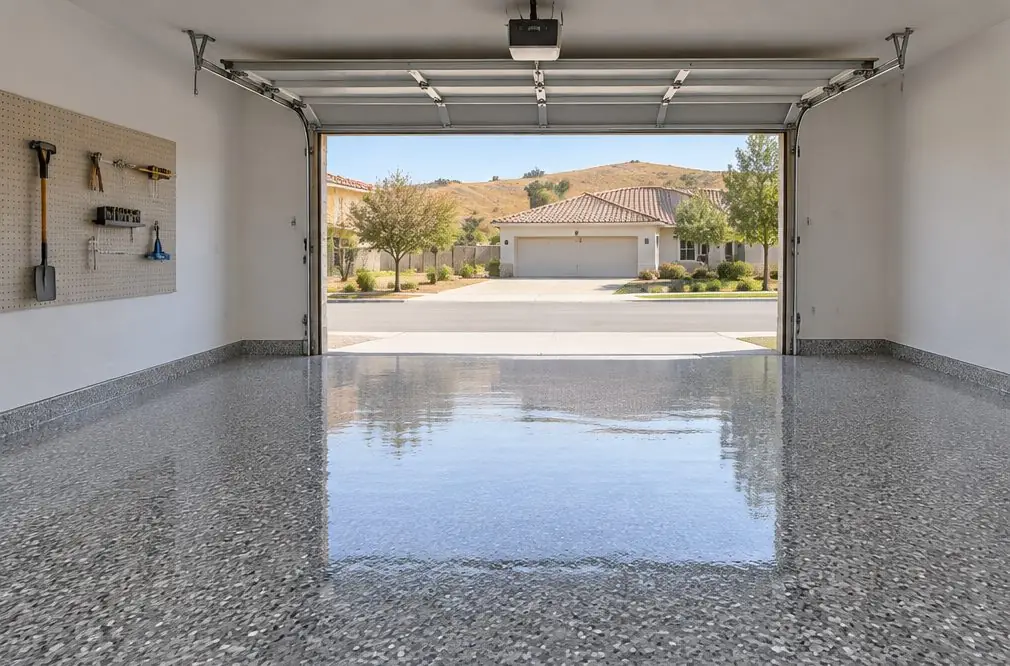
Epoxy Floors Craft Antioch looks at a typical two-car garage job in Dallas Ranch: about 420 square feet of full-broadcast flake epoxy on a 1990s slab with minor cracks, the cracks filled and ground flush before the base coat, and a UV-stable clear top coat for the afternoon sun.
Bookings aren't open yet. Leave your name and number; your message is recorded, and you'll get one message when a local installer is available.
Worked example. The pictures are AI concept illustrations, not photographs; no installation was performed or arranged through this site; prices are typical Antioch area market ranges, not quotes.
 Illustration
Project Examples & Typical Prices
The scenario
The house is a 1990s single-family home with a two-car attached garage. The slab has never been coated, but a few hairline shrinkage cracks cross it, and one runs from a corner toward the center. The household parks both cars inside and wants a floor that hides dust and tire marks.
The garage door faces west, so the floor sees the afternoon sun in summer when Antioch's mean daily high is 91.1°F in July. The installer proposes a full broadcast for the look and a UV-stable clear coat for the sun.
One crack is wider than the others and is priced as an extra repair area.
The cars leave in the morning and return hot in the evening, so the part of the floor that matters most is under the tires. The household has seen a faint stain from a slow oil leak under one parking spot. That spot is degreased and ground twice, since oil in the pores keeps a primer from soaking in.
The household asks about color. A mid-tone gray blend with charcoal and white is chosen because it hides the dust of a dry Delta summer and does not get hot to the eye under a west-facing door.
What the job involves
- The household empties the garage and the installer maps the cracks, checking each for movement and for a lip between the two sides.
- A dust-shrouded diamond grinder grinds the whole slab, and a vacuum collects the dust.
- Cracks are cut, filled and ground flush; the wider crack gets a second pass.
- A moisture test is made on a few bare spots, and the readings are kept with the job notes.
- The pigmented epoxy base coat is rolled out in sections and flakes are broadcast by hand to full coverage.
- After the base cures, loose flakes are swept and scraped and a UV-stable clear top coat is applied.
Materials and prep
- Dust-shrouded diamond grinder and HEPA vacuum
- Crack-chasing tool, repair filler and primer
- Pigmented epoxy base and vinyl flakes in a gray blend
- Clear top coat, rollers, scraper and spiked shoes
What it typically costs in the Antioch area
| Flake (chip) epoxy, 420 square feet installed ($6–$9 per sq ft) | $2,520–$3,780 |
| Minor cracks, pits or spalls to repair (+$1–$2 per sq ft) | +$420–$840 |
| Extra crack or joint repair (per repair area) | +$50–$200 |
| Typical total | $2,990–$4,820 (market range, not a quote) |
These are typical local ranges, not a quote or an offer; an installer prices the actual job after seeing the floor.
Add-ons often paired with this job
- Custom flake blend — +$100–$300. A custom flake blend is priced as a separate line.
- Coat the stem wall (garage-door threshold wall) — +$150–$400. The garage-door threshold wall can take the same system.
- Moving garage contents out and back — +$100–$300. Moving a workbench and shelving is a separate line.
Why it is done this way
Two things drive this price: the size of the garage and the cracks. A shrinkage crack that is filled and ground flush will usually stay hidden; a moving crack can show again, which is why the installer checks each one.
The top coat is the sun's answer. Epoxy can amber in sunlight, and aliphatic polyaspartic or polyurethane top coats are generally more UV-stable.
The cracks deserve a second look at the end. The installer returns to the crack map after grinding, checks whether the gap between the two sides has changed since the first visit and photographs each repair before the base coat goes over it, so there is a record if a crack shows again.
The finished floor is a two-car floor that stays easy to sweep. Full broadcast leaves a slightly textured surface, and the clear coat makes it wipeable with a damp mop.
What would change the price
- One of the cracks has one side higher than the other, and a concrete professional is asked first.
- A moisture test reads high and a vapor-barrier primer is added.
- Old paint is found on part of the floor and must be removed.
- The household picks partial broadcast, which lowers the flake bill.
- The garage measures 20 by 24 feet instead of the typical 420 square feet.
Where this leads
- Service page: Flake Epoxy Garage Floor — The decorative system most garage price guides list first, with the layers, the broadcast choice and the top coat explained.
- Local page: Epoxy garage floors in Dallas Ranch
- All services and typical prices: Epoxy garage floors in Antioch
- More worked examples: Project Examples & Typical Prices
Check availability and the price range for this setup
Bookings aren't open yet — a typical Antioch range in about 30 seconds.